
One of the cool things about blogging is that I can do things like begin a post like a nerd, debating with myself the question of genre. Hamilton: An American Musical is a play, but I don’t have a column for plays. Yet a play follows a script; if there’s any hope left in the humanities, everyone has read some Shakespeare, so is a play technically literature, or are they analogous to movies or TV shows because they rely on performances and not readings alone?
Insert nerd emoji here.
To celebrate our 21st wedding anniversary, I took my wife to see Hamilton: An American Musical while it was touring in Detroit. The idea began as a conversation with one of my peers, who maintains some sort of insider’s membership at the Fisher Theater. At the time, Wicked: For Good was playing at the movies, and she couldn’t wait for it to return to its on-stage version so she could see it again. I mentioned that after seeing Hamilton during the COVID years, I couldn’t imagine a better musical. She let me in on the preorders for tickets with an exclusive link!
Re-reading my review, I levied the following critique:
Speaking of focus, Hamilton is a recording of a live performance, and so at times tries to simulate a stage experience, and other times, a movie. The camera tries to track the central characters at all times naturally. However, this diverts attention from some of the choreography happening simultaneously on-stage. Background activity, such as when Hamilton asks Elizabeth Schuyler’s father for her hand in marriage while she sings “Hopeless” in the foreground, would be great to see if the cameras cooperated. Likewise, I would love to be able to rewind and watch all the elements of the…”rewind”…that takes place preceding Goldsberry’s “Satisfied,” with all of the extras dancing backwards to simulate Angelica Schuyler’s remorseful recollection of the event when she and her sisters first meet Hamilton. By the time the song finishes, the stage is back to her toast of Elizabeth and Alexander’s wedding. Such are the limitations of a “cinematic” version of a stage play.
I am pleased to report that the live performance of Hamilton meets my expectations. Not seeing the original cast disappointed me only slightly, but that is to be expected for a musical on tour for the past decade minus the pandemic pause. Sitting dead center in the third row (I love my wife!) resolved my only real complaints of Hamilton (2020). I could now observe all the on-stage goings-on such as the Ensemble frolicking about the stage, gracefully manipulating scenery while providing background vocals.
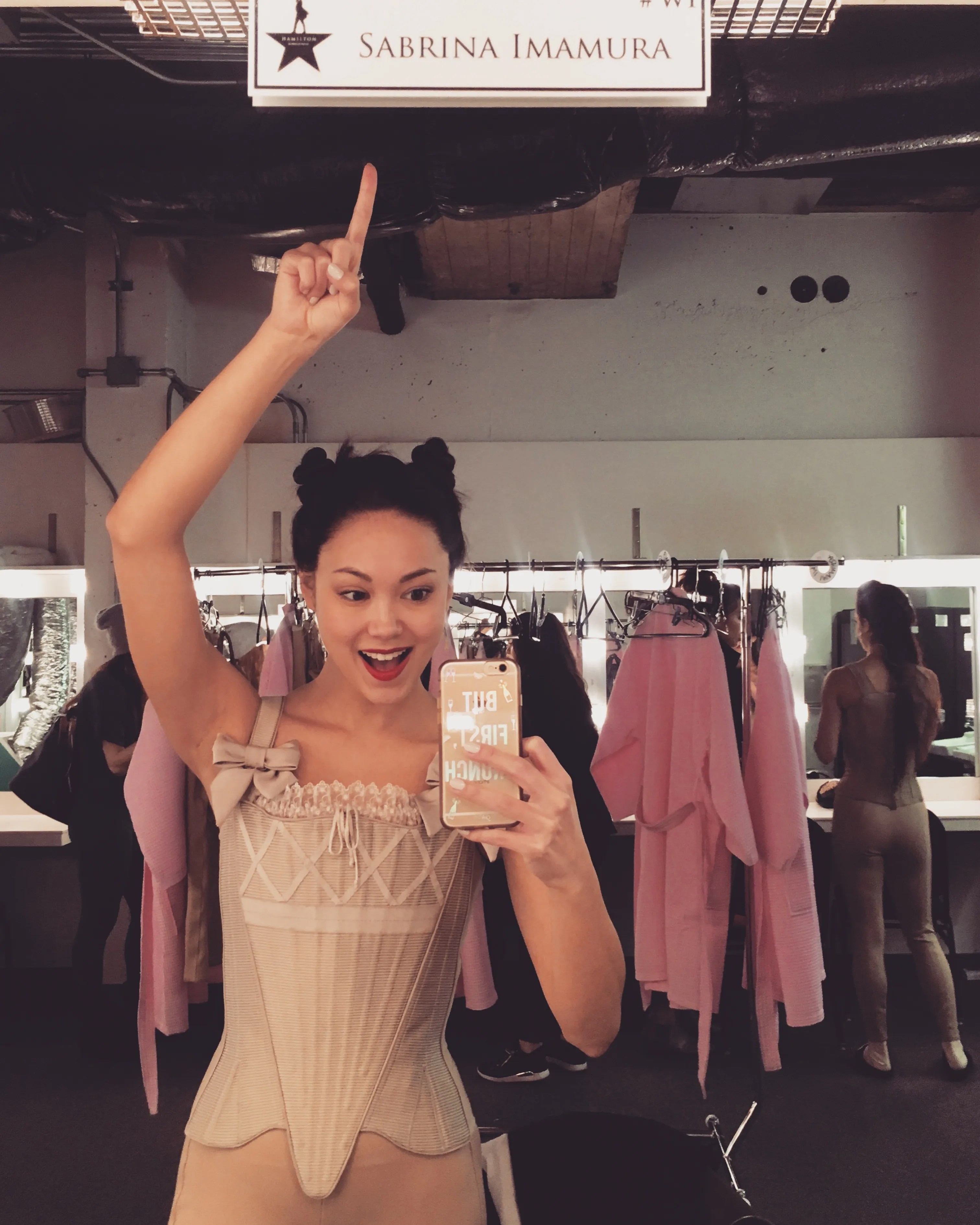
Yes, I want to begin with a special shout-out to the Ensemble, capitalized like a character in the playbill, because they were ON IT! Not only are they actively changing costumes more frequently than the main cast, but they also play as the occasional minor character such as Charles Lee who has lines, or Philip Schuyler who has no lines, but lurks in the stage’s background during various scenes. It’s absolutely captivating listening to the Ensemble harmonize with the Full Company for the final line of “History Has Its Eyes on You.” Sabrina Imamura in particular impressed my wife; apparently her twerking at the center of the stage as Thomas Jefferson, James Madison, and Aaron Burr dance on the grave of Hamilton’s presidential hopes during “The Reynolds Pamphlet” is a performance highlight.
My favorite visual eye candy comprises the stagecraft necessary to perform “Satisfied.” I quote my lamentations above concerning my inability to see everything as the Ensemble reverses the stage, and I am now…satisfied. Otherwise, Marja Harmon is serviceable.
Neither listening to the official Hamilton soundtrack release nor watching the 2020 film does justice to the live experience. The Orchestra positioned in a pit below the stage thunders with some instrumental combination simulating cannon fire during “Right Hand Man.” Many instances such as these enhance the live experience.

My only critique concerns Jimmie “JJ” Jeter as Aaron Burr. “Wait for It” is my second-favorite song in Hamilton after “Yorktown,” and its requirements expose Jeter’s limitations. His nasal delivery reminds me of Keith Sweat, and I could no longer look upon him favorably once I pegged his style. Upon this [redacted]th viewing, how Hamilton characterizes Burr as Machiavellian doesn’t do him any favors.
The rest of the cast is fabulous. Tyler Fauntleroy as Hamilton is an upgrade over Miranda’s soft voice. Portraying Hamilton as an underdog suits Miranda appropriately, but Fauntleroy is more convincing playing a poindexter that anyone would listen to. Likewise, A.D. Weaver as George Washington intimidates on stage, both with his bass voice and also his stature. Weaver is a BIG DUDE on stage, suitable for playing a general who, according to my takeaway from watching Ken Burns’s The American Revolution documentary, was more bark than bite. Weaver nailing the last notes several octaves above his bass in “One Last Time” encroaches upon comedy because of the incongruity. Impressive stuff.

Matt Bittner conserves himself for a compact performance as the fan-favorite King George in contrast to Jonathan Groff’s smug flamboyance. I hardly noticed Christian Magby as Marquis De LaFayette, but he has almost too much fun as Thomas Jefferson. Jefferson is only an Act 2 character, but the way Magby lays it on so thick that he becomes the central character of the play. It is likewise with Eddie Ortega’s Hercules Mulligan, whose vulgarities enjoy Act 1 highlights while he is otherwise minor. Ortega’s James Madison in Act 2 compliments Magby’s Jefferson. They are totally bros, and as I mention in my 2020 review, one nearly forgets that they are the southern, slave-owning kind of “bro.” Seriously, Magby acts a fool, out-clowning Bittner’s King George in the most complimentary way. The man has aura and it’s great!

Lili Soto as Eliza crushes “Burn.” Before our very eyes, she transforms from a petite, meek housewife who occasionally call-sings her sister’s like an enchantment into a woman so scorned that she would destroy all records of her affections toward Hamilton. Soto’s delivery of these lines nearly blew me out of my seat:
The world has no right to my heart
The world has no place in our bed
They don’t get to know what I said
I’m burning the memories
Burning the letters that might have redeemed you
You forfeit all rights to my heart
You forfeit the place in our bed
You sleep in your office instead
With only the memories
Of when you were mine
I hope that you burn
To shamelessly copy how DotA 2 Powerpoints ends its videos, Hamilton is good, and you should see it. Preferably live.