
Spitballing ideas for a new column on my blog, I asked for the opinions of my youngest offspring unit. I told him that I was thinking about “Smash TV,” but that might confuse people because it’s a video game allegory. I considered “Netflix and Chill,” but folks might get the wrong idea concerning my content. At any rate, most millennial do not necessarily watch TV anymore; we steam these days. So I suggested “Slipstreaming,” and he appreciated the racing reference: slipstreaming is an aerodynamic technique where two moving objects align in a close group to exploit the lead object’s slipstream and thus reduce the overall effect of drag. So for example, during the Tour de France, a trailing cyclist may use the lead’s slipstream to pass them at the stretch.
In the context of social media, I am aware that people will “live watch” popular shows via Twitter that site Elmo purchased for $44B yet is only worth $9.4B now. Rather than live watch/tweet shows, especially when episodes are released weeky, I prefer to wait until the entire season is finished—preferably the entire series—until I partake. While I am immune to FOMO (fear of missing out), I am not immune to the feeling of needing another fix, and the wait between episodes is often excruciating. Besides, arriving late to the discourse means that should I decide to write about some media, I can draft or “slipstream” behind everyone else for the LTTP (late to the party) crowd.
Hey, it sounded cool in my head, okay!
Avatar: The Last Airbender (ATLA ’24) is not a television show that we necessarily asked for, but it is one that we deserve. The 2010 film, The Last Airbender, is an anthema to fans of the original Nickelodeon show—a travesty, an insult. This, everyone but Manoj Nelliyattu Shyamalan knows already. Effectively a redo, ATLA 2024 seeks to correct the mistakes of the film, from the botched special effects to whitewashing of the cast. Rather than merely write about how faithful of an adaptation ATLA ’24 is to the original, I would like to rank the characters/actors in terms of their performances, from worst to first.
Uncle Iroh

Paul Sun-Hyung Lee’s General Iroh is one of the most disappointing performances in the history of acting, let alone ATLA. I do not know how else to express the excruciating experience that is Lee’s navigation of Iroh as a character without risk of hyperbole. Lee looks the part certainly enough, but when he opens his mouth, I find my soul exiting my body, leaning at the edge of its spiritual seat with the hopes that he will successfully land a line, providing my spirit hope that he will figure out the character as the episodes and season go on. Unfortunately, every step forward precedes a backward leap. Where OG Iroh is cunning, Lee is naive. Where OG Iroh is supposed to be clever, Lee’s is aloof.
And so on, not because Lee understands Iroh’s dynamism, but because his understanding of the character is fundamentally flawed. He sounds like he was told what his lines were supposed to be before every take, no rehearsal. Him looking into the screen while reading a teleprompter may have yielded a similar result.
The portrayal is unbearable.
Azula

Azula appears twice in the first season of OG ATLA; to my recollection, they are both speechless cameos. The audience does not know much about her except that Zuko fears her. However, ATLA’24, provides Azula an entire original character arc.
But why tho?
ATLA ’24 gives its audience the impression that Azula had to earn her father’s favor through practice before he would send her out on a mission. Having Azula grind training sessions violates the drama rule of “show, don’t tell.” We already know that Azula is “Da Baddest B____” because S2E3 of OG ATLA reveals she has conquered Omashu and wants to rename it to honor Lord Ozai. OG ATLA characterizes Azula as diabolical. Calculating. Precise. She shows no signs of coming off the hinges until the climax of season 3, but ATLA ‘24 hints at her mental and emotional insecurities when she is supposed to be stone cold ruthless.
Additionally, a feature I remember most about OG ATLA Azula is how her chin points almost like a triangle. Actress Elizabeth Yu has a much rounder face. Looking at the side-by-sides between the actress and the character, I can acknowledge that OG Azula did have rounder cheeks than I remembered. Even so, Yu’s soft features betray her efforts to engender perpetual rage. I dislike that she is beautiful like one should expect a princess to be; then again I never really thought about OG Azula as attractive because she’s a teenage cartoon character. Ok time to stop typing about this character now.
Aang

Gordon Cormier is a child actor, which is appropriate for a character who is a 100-year-old child. Unfortunately, good child acting is hard to come by, and ATLA ‘24 is no different. OG ATLA Aang can deliver a line, and the animators illustrate facial expressions to match his own from serious to joyful all with cartoonish emphases and embellishments. A critic measures the talent of a real-life actor based upon their capability to muster these kinds of expressions for effect. One need not be versed in theater to determine that Cormier plays director’s marionette for every scene, which translates to the kind of overacting to be expected in parodies. He does not “own” the role as we say Robert Downey Jr. “owns” Tony Stark; Cormier merely cosplays as the Air Nomad known as Aang. It may be unfair that the weight of the entire show falls on his small shoulders.
Prince Zhuko
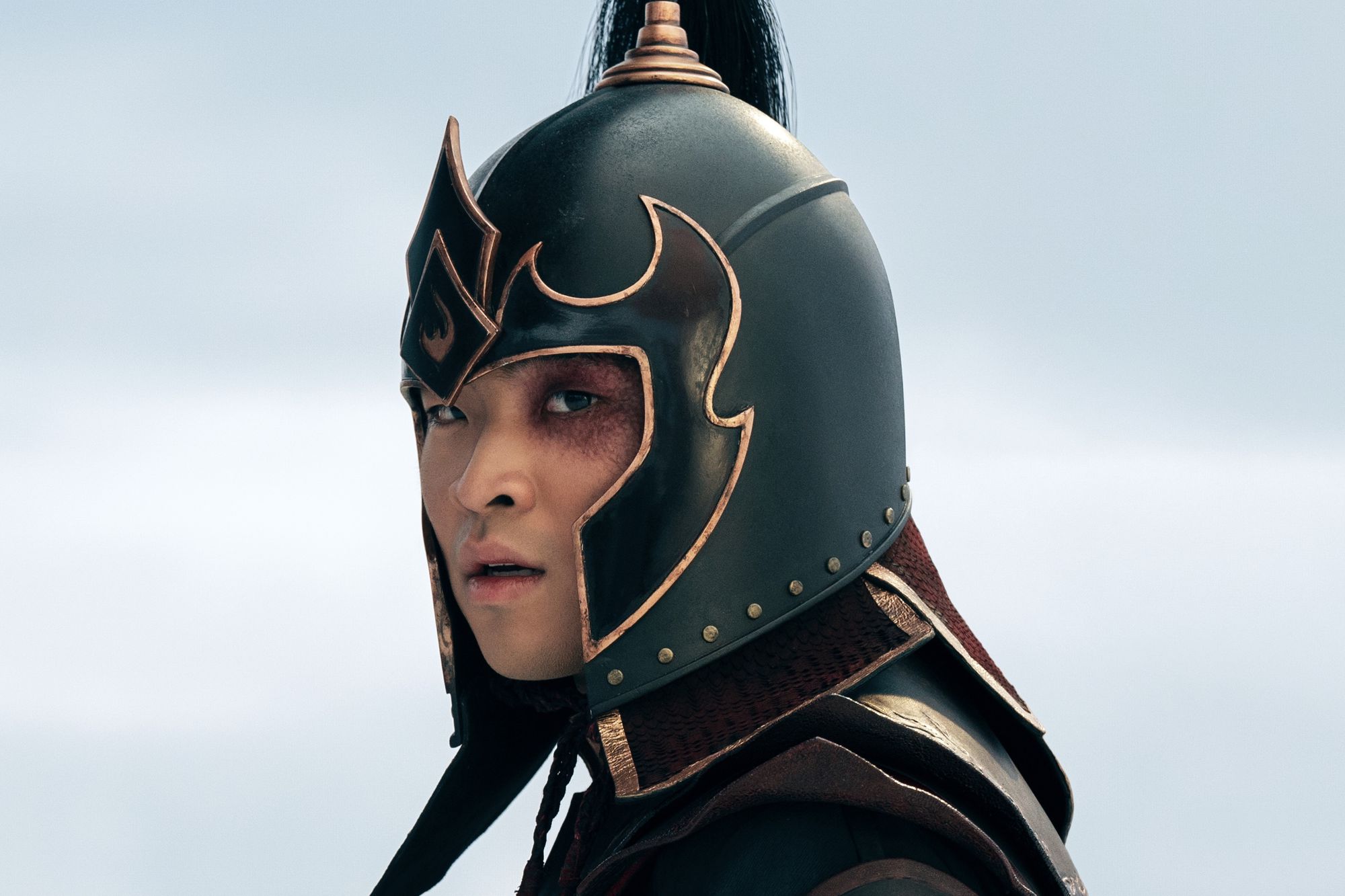
At least Cormier has the excuse of barely being a teenager at the time ATLA ‘24 was filming. Dallas Liu was a grown man playing as Prince Zhuko, yet the quality of their scene-to-scene acting is similar. In that regard, I considered ranking Cormier’s Aang higher, but Liu’s mission is to portray a convincing Zhuko, and he mostly succeeds. It is not his brooding and brashness that I care for, but his ponderous, reflective side. OG ATLA gave us glimpses of multidimensional Zhuko even as early as season one, and ATLA ‘24 replicates this. Zhuko is best not when he fumes with insolence and entitlement as the heir to the Fire Nation throne, but when he is just a boy who seeks approval from his father. He is, unequivocally, ATLA ‘24’s deuteragonist.
Fire Lord Ozai

I consider Ozai to be my baseline expectation for character portrayal in ATLA ‘24. Ironically, I initially did not have expectations for him at all in ATLA ‘24 because he actually does not appear for the first time in OG ATLA until S3E1! Yet here he is already in ATLA ‘24’s first season, in all of Daniel Dae Kim’s handsome splendor.
There is not much to critique here; Ozai is essentially adult Azula but without the insecurities. The take-over-the-world-whilst-forsaking-all-others types lack nuance. At least Kim adds a layer of smugness to OG Ozai’s regalness. Bonuses like that are what we look forward to experiencing with live adaptations.
Katara

Here is the part where I humbly admit how much easier it is to lambast the characters and acting that fall short of my expectations than extol the accomplishments of those who master their craft. Kiawentiio demonstrate how it’s done. The Katara’s benevolence and optimism provides a warmth prior unknown to the artics of the Northern and Southern Water Tribes. Her ultimate test in Book One would be her duel with Master Pakku, the culmination of her evolution from a defenseless girl at the beginning of the season to a master water bender. Kiawentiio had yet to falter up to that point, and she preserves her streak of nailing every scene where Katara appears.
By the time Katara duels Zhuko during the season finale, the actress’ character is already fully-realized. The audience is convinced that she can fight at least to a stalemate, an accomplishment that I do not believe even Aang is capable outside of the Avatar State. Again, I don’t have much to say because Kaiwentiio portrays Katara masterfully. I look forward to how Katara will develop further.
Commander Zhao

At this end of the spectrum are the characters in season one who exceed my expectations. Ken Leung masters the role of Commander Zhao. His evolution from an officer forsaken in a tactically irrelevant region in the world to admiral of the Fire Nation’s northern armada that would lay siege to the Northern Water Tribe impresses. While a visit from an impudent Crown Prince Zhuko inconveniences Zhao’s officers, Zhao himself interprets the interaction as an opportunity. His demeanor disarming, Zhao maneuvers Fire Nation politics approximate and abroad with perspicacity.
Zhao is such a cunning villain that I wish Lee would have taken some cues.
Sokka

In OG ATLA, Sokka is the least popular among the core cast as the annoying, “comic relief” character with no water bending powers. Well, Ian Ousley transforms Sokka into not merely likable, but the best character in ATLA ‘24. As Aang would have benefitted from cartoonish emotional expression, Sokka is the opposite; the live-action adaptation does justice to his sarcastic humor.
In a world full of elemental benders, Sokka’s cynicism shines as he represents the regular folk. With the serious tone ATLA ‘24 brings, Sokka is right at home. With the overall lightheartedness of the show retired, Ousley’s Sokka now more accurately behaves like a young person who had to become a man faster than he would have liked because of the ongoing war the Fire Nation had started.
One thought on “Slipstreaming—Avatar the Last Airbender (S1, 2024)”