SPOILER WARNING!
My kids had to update me on the Direct that went live on 4/2/25 because I’m not a Nintendo fanboy. They told me Hollow Knight: Silksong would release on the Switch 2 sometime in 2025. Cool. I’ll celebrate when it gets here, I said. After waiting seven years for Ghost Song, I refuse to grant announced games more energy than necessary, notwithstanding my ongoing list of Black game dev projects yet to come. By the time developer Team Cherry all but shadow dropped Silksong with only a two-week warning and a video game industry-breaking $20 price tag*, I had already planned a staycation because I had PTO to use-or-lose before my mid-September work anniversary.
Because I consider Hollow Knight the greatest Metroidvania of all time, I determined the likelihood that Silksong could meet or exceed its predecessor minimal, so remaining patient was easy. I am pleased to report that it meets seemingly impossible expectations as Team Cherry expands into a robust stand-alone game what the developer trio originally conceived as a DLC for Hollow Knight. Silksong transcends its predecessor in aesthetic splendor, airtight mechanics, and sheer scope. It’s the most beautiful 2D game I have played since Ori and the Will of the Wisps, intrigues with an open design that allows players to explore its dozen-plus biomes well before players have any business doing so, and, to that prior point, captivates by upgrading Hornet into the aerodynamic warrior whose skills encourage player expression.
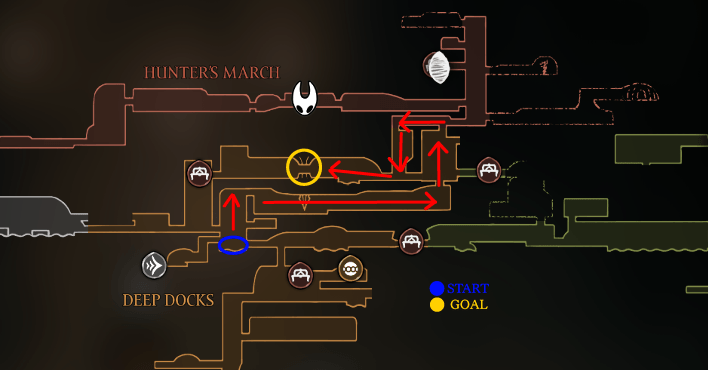
Don’t leave the Deep Docks without the most important upgrade in the game!
Infamous among Hollow Knight’s features is its difficulty. I believe it scales like a bell curve—difficult, peaks, and proceeds on a downhill slope. The Hollow Knight and the Radiance were relatively easy compared to what I endured to fight them. In contrast, the difficulty in Silksong feels more like a plateau—remarkably steep at first, then consistently challenging for its entire duration. By the time I unlocked Act 3, I was battle-hardened. Early game Hornet is slow and fragile; many (pre-patch) obstacles and enemy attacks deplete two units of health. My first skill check moment—when the game’s difficulty flustered me—took place not against a boss, but a Skarrgard in what players are calling a mob rush, a room that traps Hornet with enemies unique to the biome before proceeding.
This is not my gameplay, but I am using this clip to unpack a series of Silksong’s distinguishing features. First, Hornet hits her cocoon before beginning the fight, a rookie mistake that I did not correct until I was 20+ hours deep. Players should enter difficult encounters like these with their silk maxed already, and only burst the cocoon after exhausting their silk for an emergency because the cocoon always restores maximum silk. Second, Hornet only has five hitpoints, so she can die in three touches. She begins the game with a healing spell called bind, but it’s paralyzing and risky to try. Third, at the 0:46 mark, Hornet makes a downward aerial strike to evade the Skarrgard’s attack, a mobility technique that speedrunners spam because of Hornet’s sluggishness before unlocking the swift step ability. Fourth, at the 0:51 mark, Hornet parries the Skarrgard’s lethal blow, the first and only time she does this during the clip. Accidental panic button press? Sudden remembrance of a mechanic Team Cherry includes but intentionally does not mention so that players can discover it on their own? Whatever the case, I did not fully implement the powerful, secret tech of parrying attacks until I had already unlocked two endings.
Fifth, and perhaps most importantly, it is not even necessary to fight this mini-boss without a dash, which would trivialize the encounter. Behold, the route to the aforementioned swift step ability bypasses the Far Fields on the map. This deviation requires no hack or sequence-breaking glitch; players only need to know how to ricochet off enemies after an attack so that they can reach a platform inaccessible with a standard jump. The barrier for this revelation is not skill, but curiosity and creativity.
Team Cherry’s level design rendering the Skarrgard encounter completely optional even though most will experience it because platformers have conditioned players to travel from east to west is indicative of their brilliance transferred into the game, and an impressive continuation of the qualitative precedent set with Hollow Knight. Pharloom doubles the size of Hollownest, and with these proportions come items, tools, power-ups, and traps for Hornet’s disposal.
Meditating on Silksong’s OST as I wrote this, I struggled to place most of its tracks during the first half dozen sessions. Perhaps the game’s difficulty demanded my focus such that I hardly noticed the music. Better critics than I will do their music theory thing on YouTube, yet I cannot resist commenting. Many Silksong tracks maintain the thematic consistency of somber melancholy, so they do not make for playlist-worthy material. Despite my disappointment and because of its quality, I curated a playlist juxtaposing Hollow Knight‘s OST with Silksong‘s. For example, I paired Hollow Knight‘s iconic “City of Tears” with “Choral Chambers,” as I believe these songs comparable. I determined Silksong‘s “Cut Through,” “Phantom,” “The Choir,” “Skarrsinger Karmelita,” and “Lost Verdania outstanding yet lacking comparison, likely because all but one are associated with bosses.
Rather than devote thousands of words to the variety in Hornet’s arsenal, I will only disclose the primary composition of mine. After a brief affair with the Beast and Reaper crests, I reconciled with the maligned Hunter crest once I learned I could upgrade it. Silk spear remained my go-to silk skill if only because I used most of my silk meter for binding anyway. The compass and the Magnetite Dice (RNGesus chance for block damage or crit strike) occupied my yellow tool slots for most of the game, with the Ascendant’s Grip added for perpetual wall clinging after the Vesticrest expansion. For blue tools, the Warding Bell saved me from dying when trying to bind during the early midgame, which I later replaced with the injector band—arguably the most important item of all because it expedites bind. The Spool Extender was useful because one can never have enough silk, at least until I found the Reserve Bind for emergency binding. The Longclaw occupied my blue Vesticrest slot. Lastly, for red tools, the Sting Shard is an early, yet useful find for grounded and aerial foes. I enjoyed using the Cogwork Wheel against grounded opponents, especially in mob rush rooms because it can roll up the wall and pass through a second time. Later though, I replaced it with Plasmium Phial, because a guaranteed damage block in a game this difficult is just necessary.
Cool details in the game: notice the scenery before and after Hornet binds the Reaper crest.
In one of Silksong‘s more refreshing features, Hornet is the very antithesis of the Knight’s silent protagonist trope. Her character, regal. Her poise, indomitable. Her voice, assertive. From antagonism to reverence, she reciprocates how others address her. After all, she was born of bug and wyrm, raised as a princess, trained as a warrior, and wanders as an uncrowned queen. She is demigoddess. Put some respek on her name!
Your threats are worthless, child. If you are my foe, stay your voice and raise your blade!
Now, if some contrarian searched eagerly for Silksong’s flaws, its thematic delivery might yield fruit, albeit only within Hollow Knight’s shadow. Pharloom’s denizens have turned thrall from a divine affliction. In Hallownest, it was the Infection; in Pharloom, it is the Haunting,” by silk and song.” As Hollownest’s residents worshipped the Pale King’s deity, Pharloom’s residents heed the urge to make a pilgrimage to the Citadel located atop the kingdom. In these ways, Silksong follows the Hollow Knight template almost too precisely.
Hollow Knight benefits from seven years of fans excavating its lore. Even I could discern its most critical details:
No cost too great, no mind to think, no will to break, no voice to cry suffering. Born of God and Void, you shall seal the blinding light that plagues their dreams. You are the Vessel. You are the Hollow Knight.
I was oblivious to the significance of the Moth tribe, the Weavers, or even the Mantis Lords despite fighting them. The only lore boss I understood was the Vessel/Hollow Knight itself. I did not understand the relevance of the Radiance when I defeated her. So, these YT summaries have been a delight for me, and I may not be the best judge for how Team Cherry circuitously delivers Silksong’s narrative underpinnings. But outside of the areas related to the Citadel itself—the Grand Gate, the Choral Chambers, Whiteward, the Underworks, the Whispering Vaults, the High Halls, the Cogwork Core, the Memorium, and perhaps the Cradle—I could not discern their relevance to Pharloom. Ironically, that’s almost as many major areas as all of Hollownest!
The main reason I am including this video is Garamond’s war cry. I get an IRL morale boost when I hear it.
I do not want to embarrass myself attempting to reconstitute the game’s story. The main threads—pun intended—in Silksong are as plain as the main threads in Hollow Knight. The meddling of another pale god has led to Pharloom’s downfall, and ministers of the Citadel who worship that pale god capture Hornet and bring her to their kingdom hoping her lineage of half wyrm, half Weaver, might make a difference with the Haunting. Still, a dozen areas in the game—the Sands of Karak, the Wormways, the Putrefied Ducts and Bilewater to name a few—make me ponder their relevance to the lore. I look forward to fans decoding the purpose of Mount Fay, or what a certain NPC did to warrant imprisonment in the Slab, among so many other details that elude me.
(As I schedule this Backloggery Beatdown to publish, The Lorebrarians channel has published an entry on Silksong!)
*I do feel bad for Hell is Us and Cronos. I hope they were successful with their September launches!
 Blerd Beats