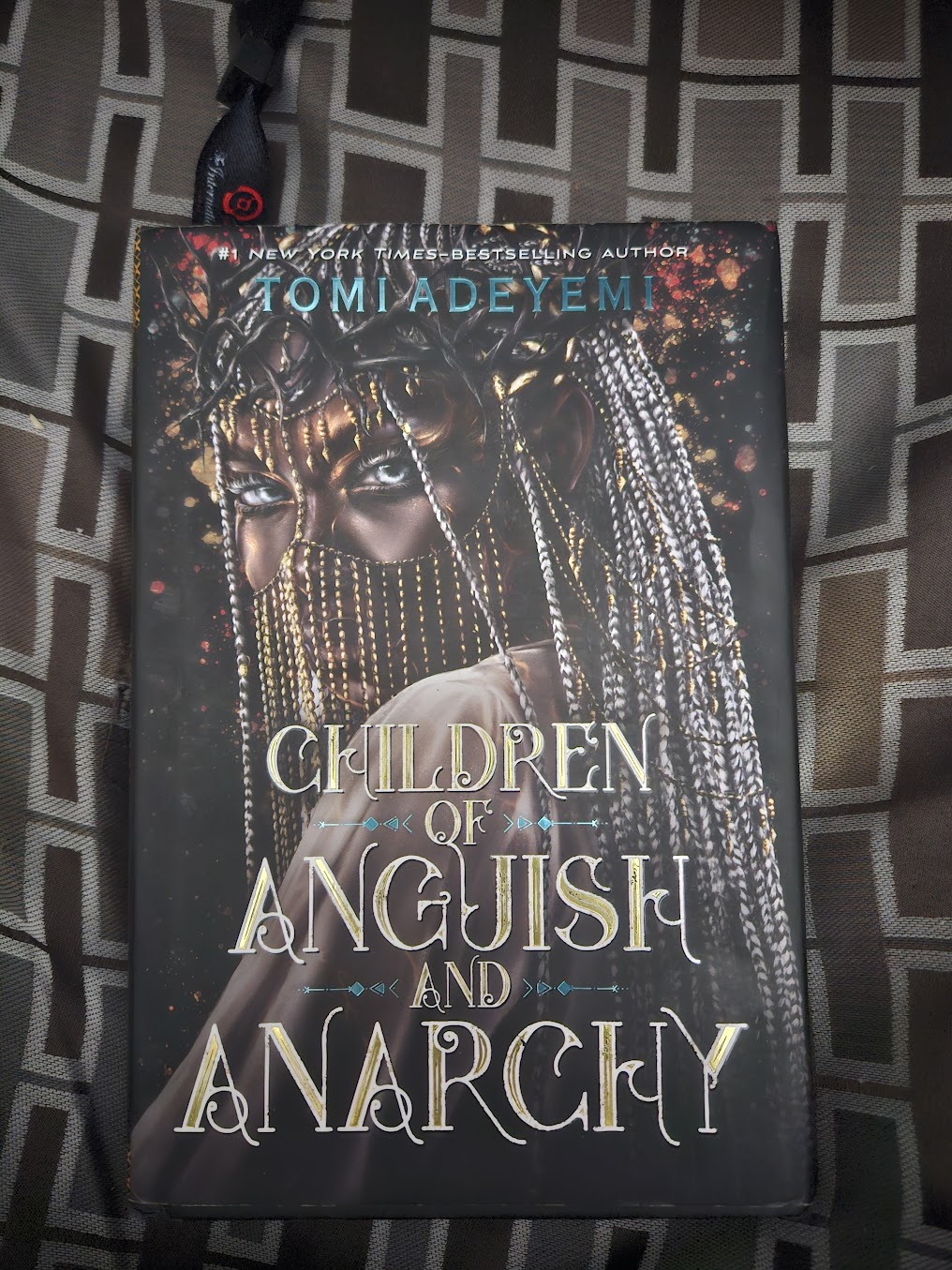
Welcome to my book column! While I’m still not satisfied with Slipstreaming for television, I’ve had Git Lit! in my pocket for a few years now. It’s a perfect amalgam for erudite blackness because of its versatility.
While I did not aspire to write reviews on Blerd Beats , I always intended to write a review of Children of Anguish and Anarchy because I wrote reviews for Children of Blood and Bone and Children of Virtue and Vengeance. I also anticipate republishing this elsewhere. Next, I will contemplate how can use this column beyond reviews.
REVIEW: Children of Anguish and Anarchy (Legacy of Orïsha Trilogy)
Author: Tomi Adeyemi
Publisher: Henry Holt and Company
Genre: Fantasy
Tomi Adeyemi concludes Children of Virtue and Vengeance with a cliffhanger. Amari determines to end the revolution by killing her brother, Iman, and mother, Queen Nehanda. Tragically, her intended targets evacuate before she unleashes the ashê of cancer maji with her tîtán powers, murdering an entire village. She deteriorates into a miserable puddle of tears when she discovers that Zélie and Roën are caught in the killzone. After healers resuscitate them, they determine to raid the palace.
After Nehanda discloses to Inan that she is directly responsible for the Raid which began the war between the divîners and nobles, he finally musters the determination to end his family’s dominion over the land. He slips her a Mickey Finn and usurps the throne. Before issuing a decree that would end the war, Zélie’s disrupts his redemptive moment with her assault. With the monarchy’s army crushed, Inan surrenders to Zélie, who resolves to kill kill him. Before she can, a cloud of gas knocks out everyone. Zélie eventually awakens on a ship.
Children of Anguish and Anarchy picks up here. Conveniently, all of Adeyemi’s favorite characters—Zélie, Amari, Tzain, and Inan—are aboard the same ship; the characters collectively provide series fans with opaque summaries of events in the previous text, Children of Virtue and Vengeance. Emphasis on fans, because neither casual readers nor new ones will have a clue what they are referencing. After all, while there was only one year between Children of Blood and Bone, it has been five years between Children of Virtue and Vengeance and Children of Anguish and Anarchy. While there is not necessarily a statute of limitations for publishing books (George chortles while diving into his sea of money like Scrooge McDuck), the considerable flaws in Adeyemi’s latest indicates that the additional time failed to yield the desirable results.
After re-reading the final fifty pages of Children of Virtue and Vengeance to reestablish myself in the world of Orïsha, the first ninety pages of Children of Anguish and Anarchy abducts its readers and transfers them for its first into the lower decks of a slave ship fleet, transatlantic style. A new villain, a tribe called the Skulls, mutilates throngs of captured maji while searching for the chosen one—Zélie. The big bad, King Baldyr, finds her and installs a medallion into her chest that saps her of her powers (or is it the majacite crown embedded into her head that Adeyemi herself forgets until the novel’s conclusion?) before Tzain leads a (slave) rebellion. When the ship goes down, Zélie drowns, and an Orïshan goddess revives her and her powers so that she can restore the powers of her shattered tribes people. From a random island, the maji rally to recruit allies to defeat the Skulls. Inan heads back to Orïsha to recruit his mother, Queen Nehanda and her tîtán army. Zélie, Amari, and Tzain head into the other direction, eventually encountering a land called New Gaīa, where they find a tribe that is as attuned to the land as the maji are attuned to the Orïshan.
After writing two entire books setting the stage of a civil war between the royal kosidán, now tîtáns, and the divîners, now maji, Adeyemi abandons about 900 pages of world-building for a hot mess. All the tension building in the Orïshan revolution between the tîtáns and maji; the love triangle between Zélie, Inan, and Roën; the uniqueness of the Orïshans and how their powers correspond to the Yoruba pantheon—all of this, Adeyemi abandons in Children of Anguish and Anarchy in favor of what honestly reads like a novel series that she might have started after finishing the Legacy of Orïsha trilogy. New Gaīa mirrors Orïsha as if it had once existed in drafts as an iteration of what would become latter. Emperor Jorah is stern toward outsiders yet tender toward his offspring as the deceased King Seran; as Zélie is the chosen one of destiny for her people, so too is Mae’e girl of prophecy as well.
Between Paramount Pictures greenlighting a Children of Blood and Bone movie and pursuing her dreams of modeling, Children of Anguish and Anarchy reads as though Adeyemi had become disinterested in finishing what she started. In order to fulfill her contractual obligation to finish a trilogy, she likely returned to her notes, taking advantage of her authorial privileges of being NYT bestseller, and barely making alterations.
That said, after Children of Anguish and Anarchy, Adeyemi is not going to beat the alligations that her Legacy of Orïsha trilogy is an Avatar: The Last Airbender fanfiction. In my Children of Blood and Bone review, I liken the maji to the X-Men, and their powers are limited by their ashê. That may have been a mistake; maji powers are no longer limited to ashê, but are seemingly limitless as Adeyemi has forgotten the rules of her own world. The Zutara shippers have been pointing at Zélie and Inan like the DiCaprio meme for years—shes the one girl who cools the rage of the firey prince. And Adeyemi herself omitting the popular character Roën altogether in this finale fuels the Zélie+Inan = Zutara parallel.
Meanwhile, Adeyemi provides Tzain, a kosidán, his own Sokka-like character arc to prove himself among magic maji. At first, he seizes one of the Skulls’ weapons that is powered by blood magic—the blood of the user. This weapon has possessive properties, mutating its user into berserker. Later, after a warrior’s trial in New Gaīa, he learns a technique that allows him to spawn weapons like Marrow. Yes, that’s an X-Men reference; I did say I may be mistaken.
It is also possible that Adeyemi pulled a GRRM, moonlighting in every vocation and hobby except writing such that her editing team might have intervened to finish the publication. I actually believe that editorial intervention began sooner. “Children of Anguish and Anarchy” describes more accurately the events of book 2, while “Children of Virtue and Vengeance” describes more accurately book 3. Furthermore, the length of Children of Anguish and Anarchy betrays the prior two volumes; at a mere 368 pages, its length is a fraction of its predecessors, and meager by fantasy standards—check Sanderson’s, or N. K. Jemisin’s work. For all of the new elements that Adeyemi introduces, Children of Anguish and Anarchy‘s length is inadequate: two new lands, two new kingdoms, two new versions of magic, a same-sex relationship, a character dying for what feels like the fourth time, a Kylo Ren moment…there are too many loose ends to count.
Children of Anguish and Anarchy is an incontrovertible disappointment. And I don’t think Adeyemi cares! On her social media, she retweeted an Elle article titled “Tomi Adeyemi Says Goodbye to Orisha.” Well, not exactly—she co-wrote the script for the film that is presently filming, and due to release in 2027. She’s just done with writing novels about Orïsha. She has also teased that she is working on a fourth book for adult audiences. One can only hope that she still has the heart for it that Children of Anguish and Anarchy lacks.
 Blerd Beats