
The original plan was to write on Damian Duffy and John Jennings’ graphic novel adaptations of Octavia Butler’s Kindred and Parable of the Sower because Butler’s works are among my all-time favorites in literature. Unfortunately, little about their follow-up graphic novel inspired me. So here we are.
Don’t get me wrong; Octavia Butler is one of the greatest novelists who ever lived. I’ve read her Patternmaster series. I’ve read her Xenogenesis Saga / Lilith’s Brood, Fledgling, Parable of the Sower, Parable of the Talents, and Kindred at least twice each (three times if one counts the audiobook versions). Yeah, her stuff is that good, which is why it feels bad struggling to get through Duffy’s graphic novel adaptations.
The artwork simply does not work for me.
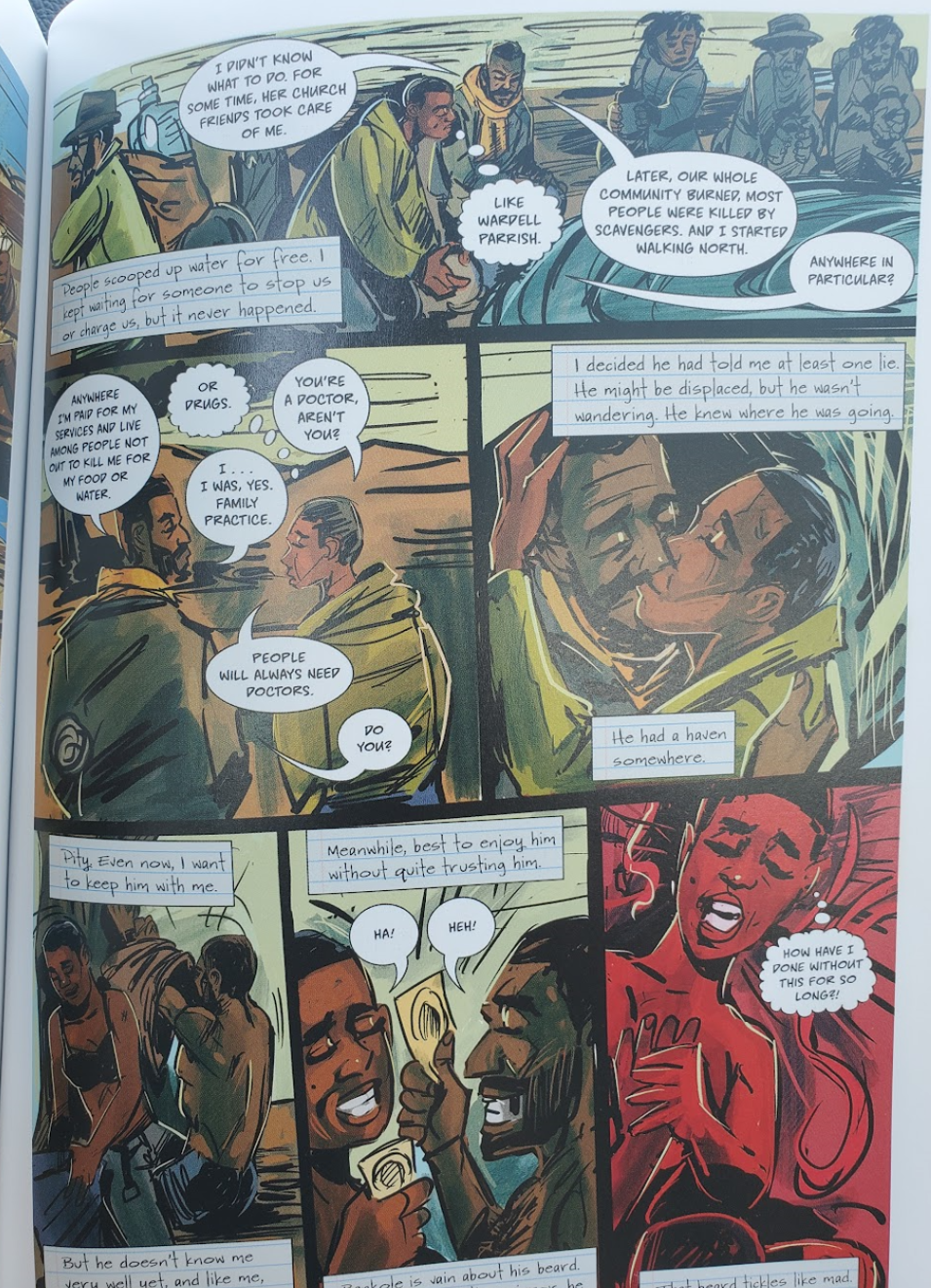
It’s crazy to think that the author of Black Comix (Returns), Black Kirby: In Search of the Motherboxx Connection, and I Am Alfonso Jones would produce work that does not visually convey the gravitas of the sublime experience that is an Octavia Butler graphic novel. I am not fond of the kind of myopic takes one finds in comments sections at Medium, but John Jennings misses with Kindred and Parable of the Sower, which is why I am writing about them in anguish. It is painful to say that these illustrations do not do Butler justice. I mentioned this in the conclusion of my previous writing on Kindred, and would like to expand on what I started here.
How Jennings portrays the protagonists in both of Duffy’s adaptations pervades problematically. The characters Dana in Kindred and Lauren in Parable of the Sower are virtually indistinguishable. Yes, Lauren intentionally fashions herself as androgynous—dare I say “masculine-presenting”—for safety. As part of the novel’s plot, by 2024 the grand experiment known as the United States had failed, and the freedoms and protections that the country and its (mostly white) citizens pride themselves on in the present have eroded. Simply put, it is unsafe for a woman like Lauen to travel in the open due to the threat of (gang) rape; she cuts off her locs. The design for Dana in Kindred, though, seems to be inspired by a young Octavia Butler herself. Because Dana zips back and forth through time, personal appearance is among the least of her concerns.

I am painfully conscious of how complaining that female characters in two graphic novels do not reflect traditional standards of beauty gives off incel energy. Notwithstanding, the critique is not so much about how they patronize the same barber, but more about how Jennings fails to draw two distinctly different characters. Lauren and Dana are virtually twins— visually the same character. Perhaps they were drawn this way under Duffy’s direction to pay Butler homage; it comes off as a lack of creativity.
In fact, nearly all characters beyond the protagonists are unremarkable. Kevin, Dana’s husband, has white hair, making him the sole distinguished character. Now both Kindred and Parable of the Sower are speculative fictions—derivatives of metafiction. With Kindred in particular, some historiography on slavery applies. Parable of the Sower is similarly undergirded by the realities of the present day. In other words, these characters are grounded, not fantastic. In that regard, some stylization is necessary to spice things up aesthetically.
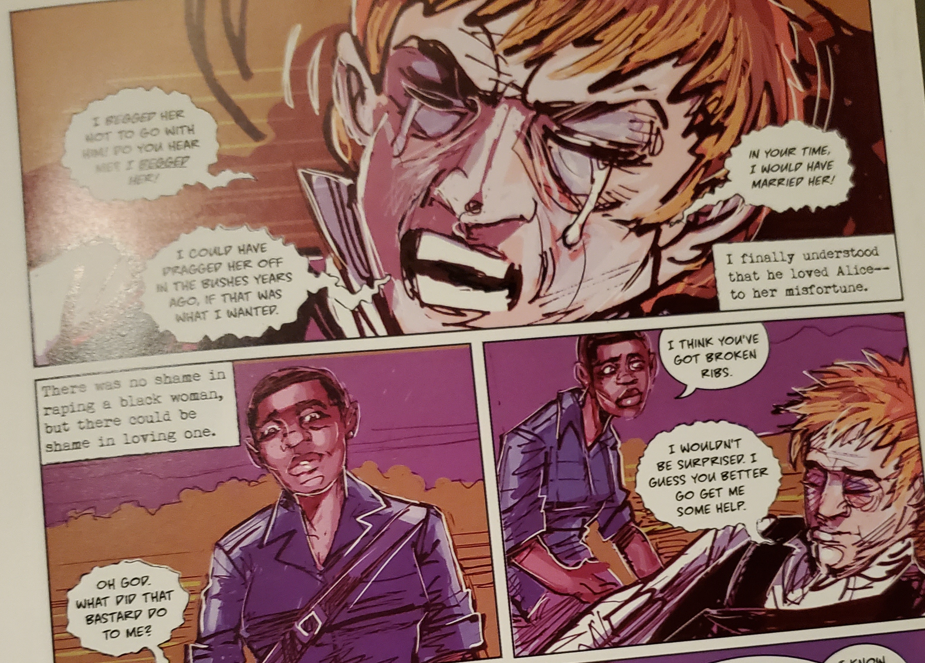
It’s unfortunate that the art is so…boring, because Duffy’s transcription of Butler’s prose is excellent.
 Blerd Beats