
A running joke among modern progressively-minded Batman fans is that Bruce Wayne is a maladjusted rich white dude who runs around all night in a spandex bat costume with briefs worn on the outside, and spends billions on tech that allows him to beat up criminals…instead of going to therapy. Chuck Brown‘s Flawed accepts this challenge. Instead of a rich white dude, the protagonist is a black woman with similar resource allocation; instead of a spandex bat costume, she wears a warrior’s regalia of an Egyptian kingdom; instead of spending billions on tech that allows her to beat up criminals, she…well…apparently does have access to some resources and combat gear.

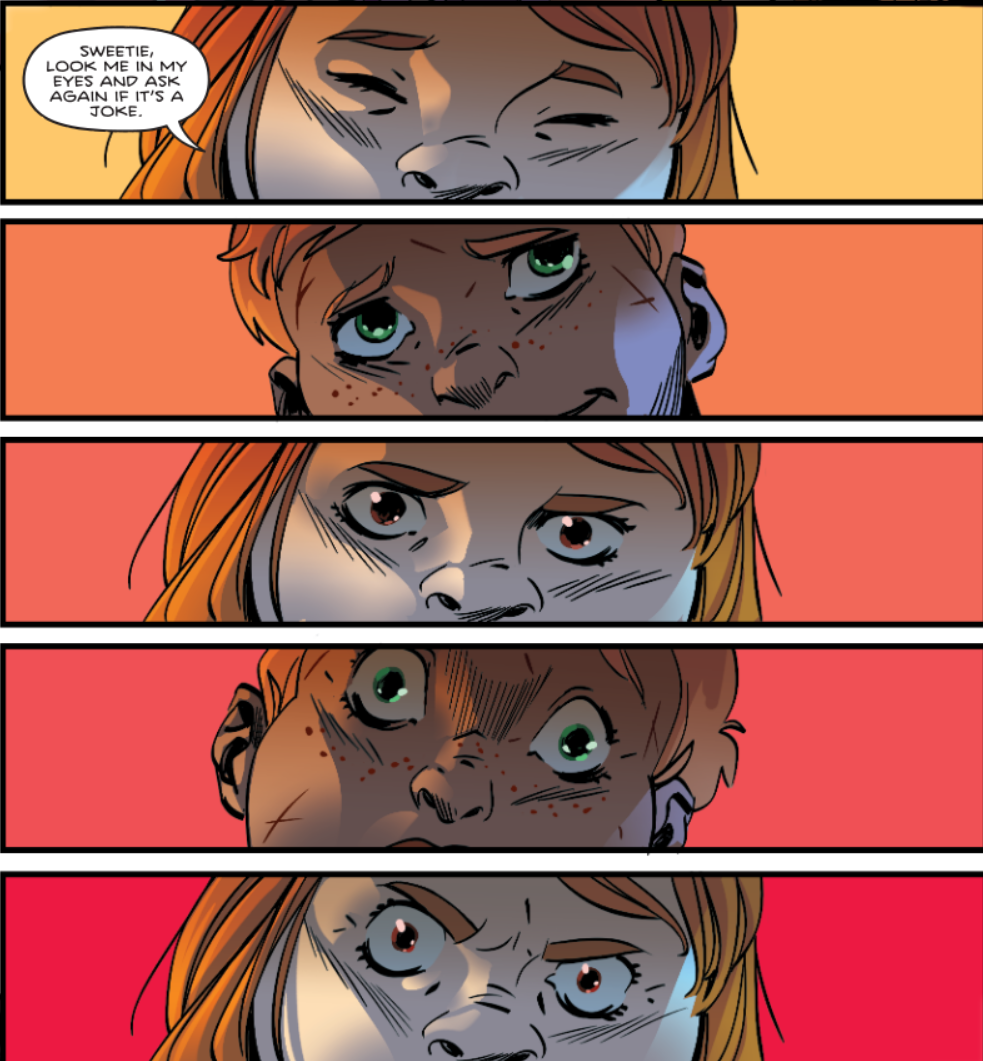
And she goes to therapy! Or rather, used to? According to her aunt Ammit, Flawed‘s protagonist, Gemma Charon Ezz has not participated in a therapy session in years. In fact, Ammit reminds her that the last time Gem sat down for a session, she confessed that she intended to dole out vigilante justice because the city of Gotham Setham is rotten and people need saving. In this impromptu session, Ammit realizes that the violence of Setham reminds Gem of the coup in Egypt that claimed her family, and so Gem find solace in waging “war” on the crime in Setham.
Indeed, the building blocks are there. Imitation is best form of flattery and all that. However, Brown’s wrinkle that Gem and her mentor Ammit are both psychiatrists as their “day jobs” is an interesting one because of how comics—the hero genre particularly—handle the topic of mental health. In an afterward, professor Julian C. Chambliss (who currently teaches at my alma mater, Michigan State University) posits how traditional superheroes pose not only as physically indomitable, but also mentally unyielding. He suggests that Superman’s mental fortitude can be attributed to his alien origin, while Batman’s infinite wealth shields him in ways that those who cannot throw money at all of their problems cannot.

I would add that Marvel compounds the invulnerable state of superheroes with the Fantastic Four, where Reed Richards’ preposterous intellect solves most problems. Seemingly realizing the unsympathetic nature of the superhero archetype, Marvel’s Peter Parker planting photos of himself as Spider-Man to sell at the Daily Bugle could be considered entrepreneurial if not also impossible in modern times when newspapers barely exist and images can be AI-generated or Photoshopped. Even though he struggles to pay the bills and make good on his date night promises to MJ, he still has a supermodel for a girlfriend, a job that is only possible in the comics, and, of course, superpowers. Parker endures his mental burdens with sheer grit, if not also channeling emotional stability through his bedrocks MJ and Aunt Mae, and memories of Uncle Ben.
In the decades since comic books were introduced, many characters have expanded on the basic premise of the [superhero] formula. Even still, they arguably continue to highlight the physical and/or mental power beyond the norm as aspirational. Disabilities can be overcome through the expansion of the mind or technology. Still, we recognize how our collective understanding of mental and physical health has begun to reshape how we understand the consequences of trauma and its effects. We increasingly recognize that the aspirational quality of a superhero can be tempered by a greater understanding of those factors that create harm and seek solutions that don’t require violence. ~Julian C. Chambliss
Yeah, about that: Flawed places at the fore the idea of those with superior physique and resources can still be…flawed…in the area of mental mettle. Only after unleashing a macabre wave of violence upon Setham to solve its immediately notable problems does Gem return to Ammit for therapy sessions. So I would not say that the comic book is successful in its premise. But I also doubt that stopping to ponder and reflect during an enemy encounter would sell worse than the average new IP.
I conclude here while teasing out a few replicated, yet nuanced the dramatis personae are in this comic. Gem’s assistant Vee channels Alfred with a gender shift and some bodily diversity; and no, I do not think her stern face is that threatening. Detective Davis reminds me of Commissioner Gordon’s early days when all of Gotham’s police were corrupt yet he was the shining star. Unique is Kelly the hitwoman, also known as Relic, who fashions herself in old styles right down to a Thompson submachine gun as a weapon of choice. Where Flawed succeeds indisputably is in the area of being a quality Batman clone.
 Blerd Beats