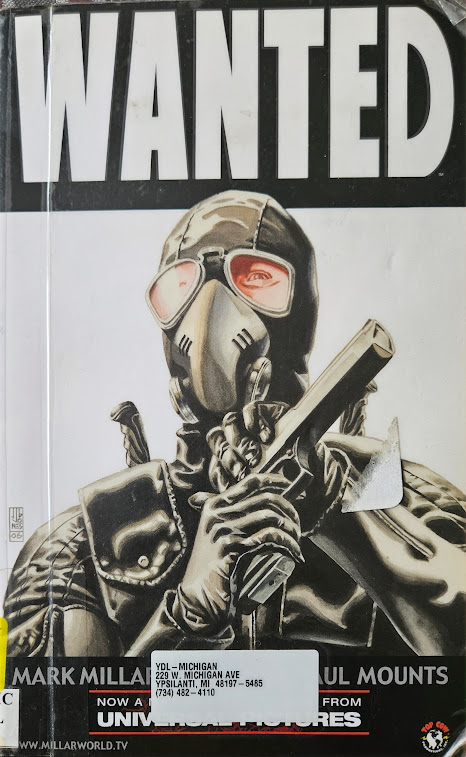
Reading Mark Millar’s Wanted was a literal mistake—I was bamboozled. Its provocative cover art lured me; the lone individual wearing a dark black combat suit with a mask to obfuscate his face cocking a pistol was insufficient, but the stylization of the title, as WANTED, resonated with me. Will Smith in Enemy of the State came to mind. I wondered what propelled this character into a fugitive state; what is it that caused a warrant for them to be…wanted? I flipped through real quick to scan for black characters, and I thought I spotted up to three. The graphic novel seemed to pass this modest yet imperative condition for me to give it any attention.

I could not have been more wrong. The character sprinkled around the comic is the Fox, an amalgamation of the Manic Pixie Dream Girl, Magical Negro, and Jezebel figure. While published from 2003-2005, in 2023 Wanted reads like an appeal, anachronistically, to incels, alt-righters, and Comicsgate audiences.
Fastidiously, I read Brian K. Vaughan’s introduction, to gain insight about the graphic novel. After finishing Wanted, I returned to this, and would like to highlight the following lines:
“…capes and tights are deceptively difficult for even the best creators to really nail. At their worst, superhero stories are just dopey male power fantasies, but at their best (see: Watchmen, Daredevil: Born Again, etc.), these myths don’t just entertain, they work as powerful allegories that help us understand who we are.
I don’t want to sound like an asshole for reading too deeply into a story with a major character named ‘Shit-Head,’ in it, but by perfectly subverting the classic hero’s journey familiar to every comic fan, Millar and Jones challenge us to think about the mundane world that we’re all part of, and the price of entry into that hidden special world we all dream of one day joining.”
Make no mistake; despite Vaughan’s deceptive verbosity, Wanted is an unvarnished white male power fantasy straight out of the Book of Dudebro, if such a tome exists.
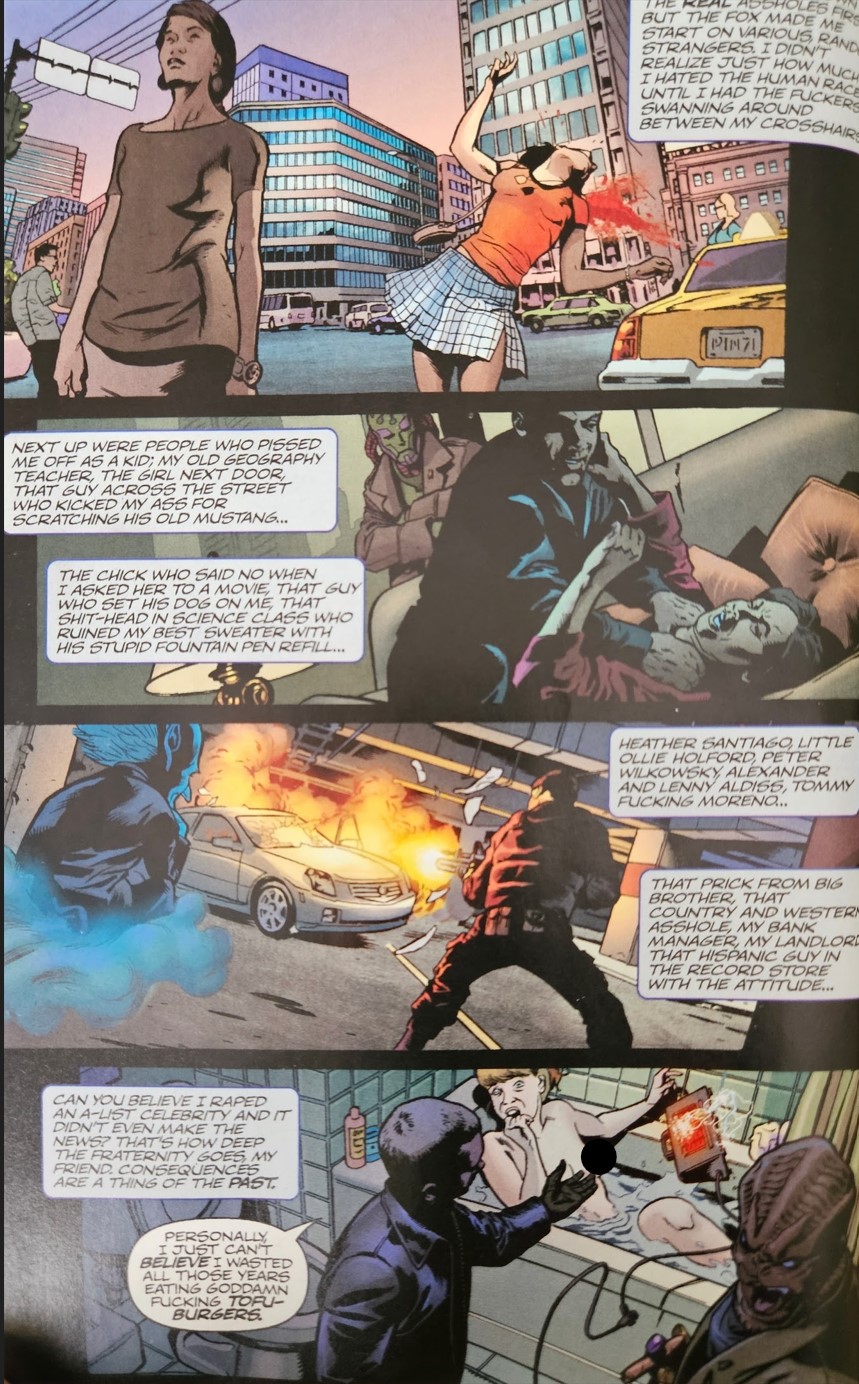
In its opening pages, “protagonist” Wesley Gibson laments how his girlfriend is cheating on him with his best friend; the more he discusses her, the more he expresses his disdain for her obesity, even though there is only one panel that artist J.G. Jones arguably depicts her as such. He complains about how he suffers under a female African-American boss, and Mexican hecklers follow him around in the streets. If this was Millar’s 2008 attempt to pepper Wanted with diversity, consider it an epic fail if not also a template for an alt-right sympathizer. Wesley is just your everyday mediocre white man surrounded by women and minorities whose very existence exacerbates his own banality.
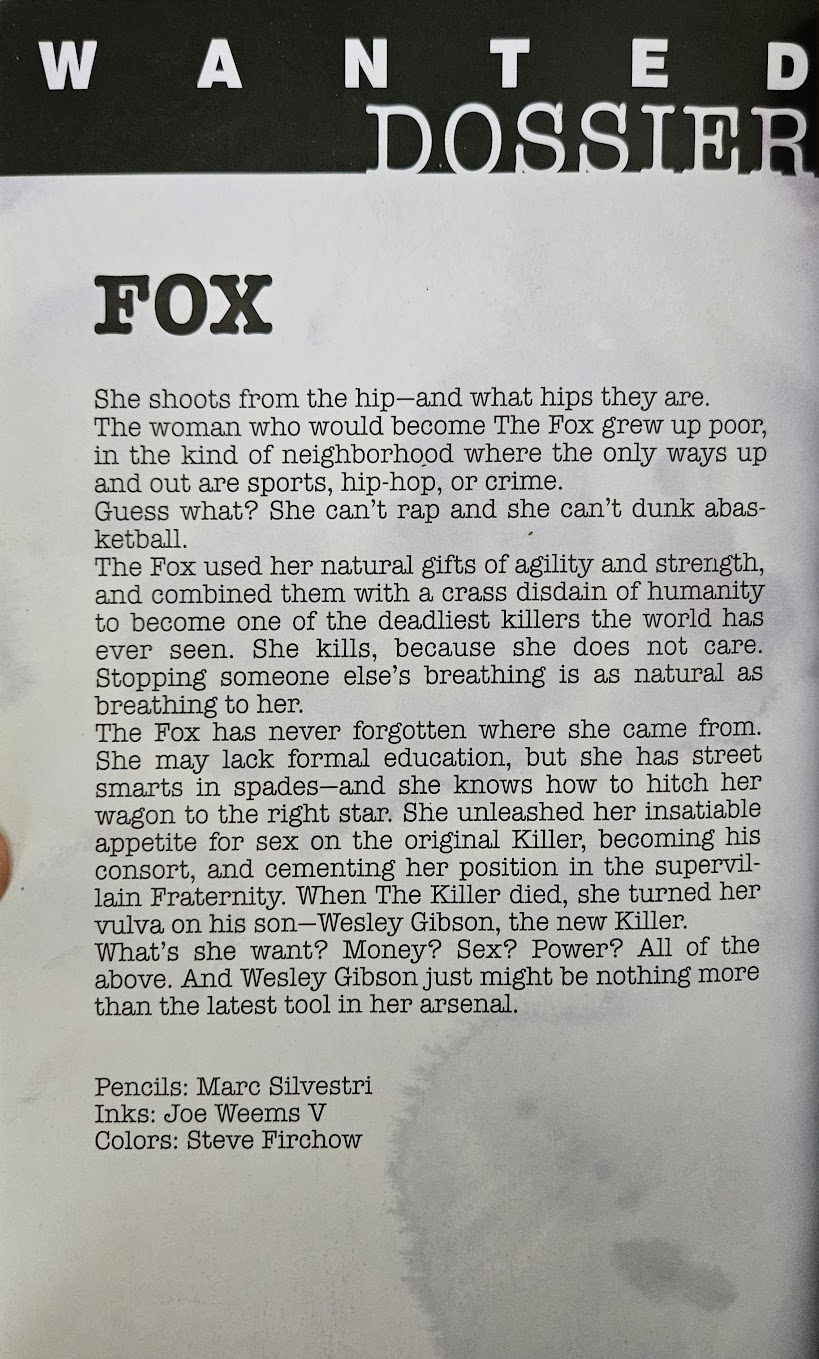
That is, until the stereotype in comic book form that is the Fox shows up in his life. Her origin story reads like a case profile from the Moynihan Report; she kills and humps her way right up the criminal ranks, right into the literal lap of the original baddest dude in the evil Fraternity. And then she makes a man out of [Wesley] with sex education lessons. So Millar creates in Fox both a Jezebel and a Magical Negro. While I will not give a renowned writer like Millar the benefit of the doubt for these egregious transgressions, the best I can manage is offer an olive branch believing that in his effort to create a believable, dare I say authentic black character, Fox remains an example of When Keeping it Real Goes Wrong.
Fox’s likeness resembling Halle Berry compelled me to consider Wanted’s publication date as well as the height of the actress’ fame in the eyes of mainstream audiences. I betray my own knowledge and age, not realizing until now that both Swordfish as well as Monster’s Ball were both released in 2001. In light of this, I cannot think of Fox as more than the repressed desires of Jones and Millar. It is plausible that many women characters in comics are as such, but Fox is especially egregious.
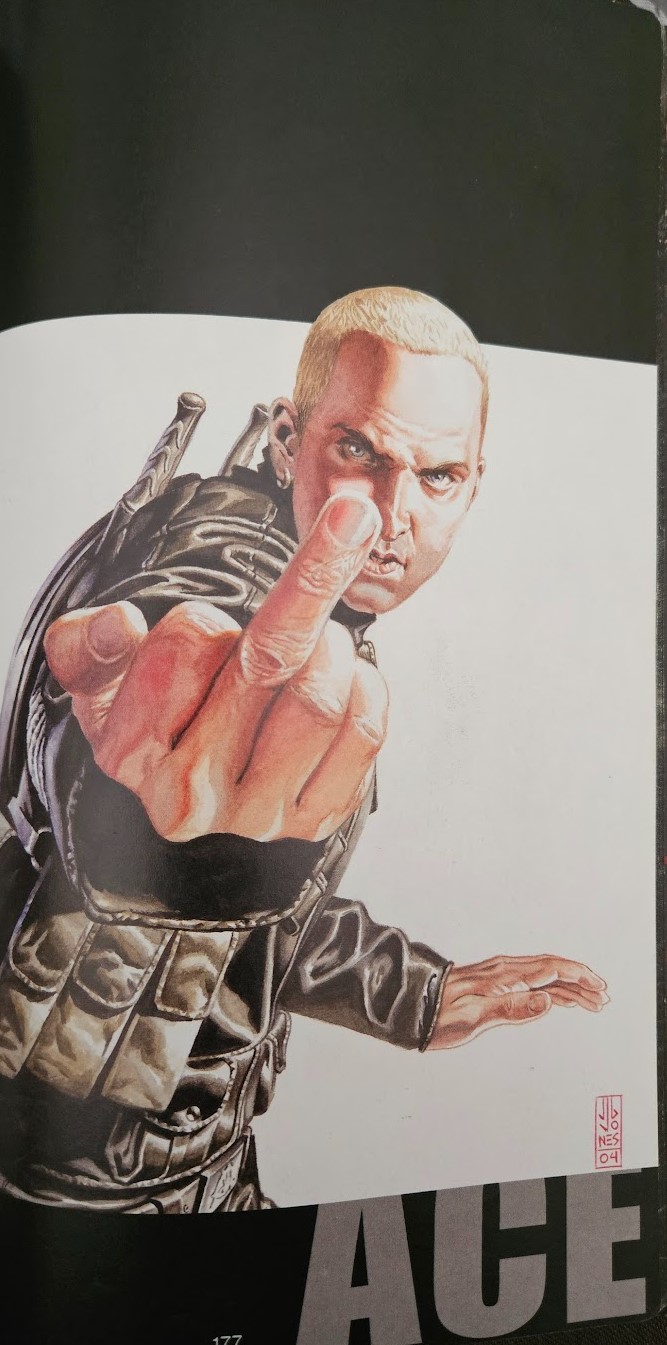
I have devoted many lines toward Fox though Wesley is the main character. I do not have much more to say about Wanted because so much bad outweighs the good. I guess that is what happens when it is the kind of comic conceived by youths in their middle school years, resurrected when those youths have achieved adulthood and built reputations. Then, such a male power fantasy might avoid outright repudiation in spite of its toxic characteristics.
 Blerd Beats